
An office electrical maintenance request should explain the problem, the premises and the work you want assessed. Start with a written scope and an access plan, rather than choosing a contractor by a broad phrase such as commercial electrical services. This guide helps Dubai office managers prepare an enquiry that can lead to a useful inspection and a clearer quotation. It does not diagnose a fault remotely or confirm that every proposed task is available at every property.
What is included in office electrical maintenance?
The phrase can describe very different jobs. One office may need a faulty light investigated; another may want a condition review of sockets, lighting and distribution equipment. An annual agreement can include scheduled visits, reporting and selected repairs, but the actual inclusions depend on its written terms. Ask the provider to separate inspection, fault finding, corrective work and ongoing maintenance. Those are related activities, not interchangeable descriptions of a single visit.
Write down the business problem first. Is a meeting room unusable because its lighting fails, or does the whole workspace lose power when particular equipment starts? Describe what you observed without deciding which part must be replaced. A request that assumes a replacement before diagnosis can narrow the discussion too early. The technician should be able to explain the findings and the proposed remedy in language the person approving expenditure understands.
Common signs worth recording
Useful observations include the time a problem happens, which rooms are affected and whether it coincides with equipment being switched on. Record flickering lights, a damaged fitting or an interruption as separate items. Do not touch equipment to check whether it is hot or try to reproduce a dangerous event for a video. A short description made from a safe position is more useful than a risky demonstration.
Consider the effect on staff and visitors as well as equipment. A dim reception area, an unreliable meeting room and a shutdown affecting access arrangements create different operational priorities. Tell the provider which activities depend on the affected area, while avoiding claims about the cause. If something presents an immediate safety concern, keep people away and obtain appropriate assistance rather than waiting for a routine maintenance appointment.
Common causes and why inspection matters
A symptom can have more than one explanation. A lighting complaint might concern a fitting, its control or the circuit serving it. Repeated interruptions might involve equipment, wiring or protection, and the correct assessment requires competent inspection. Online descriptions and photographs cannot establish which explanation applies. Ask how the proposed diagnostic work will distinguish possibilities and what evidence will be supplied before a substantial replacement is recommended.
DEWA’s public summer guidance emphasizes the condition of electrical connections and avoiding overloaded equipment. Use that as general safety context, not as proof that heat or overloading caused your particular problem. The linked guidance does not establish Fixpoint’s authorization for a project. Required contractor qualifications, approvals and building permissions must be checked for the actual work, through the appropriate responsible parties.
Safe preparation and what not to do
Keep preparation focused on information and access. Find previous inspection notes if you have them, identify the room names and list equipment that cannot simply be switched off. Share only documents needed to assess the job; remove employee, customer and account information from screenshots. Never send passwords to a maintenance provider as part of a general enquiry. A floor plan can be limited to the relevant work area.
Do not remove electrical covers, bridge a protective device or ask office staff to investigate inside a cabinet. Do not treat a maintenance article as instructions for electrical work. Where the condition appears dangerous, do not continue using the affected equipment to keep the office running. The appropriate response depends on the situation and may require immediate emergency assistance, building management or a competent electrical professional.
When to call and how the service should work
Request professional assessment when a fault recurs, when its origin is unclear or when repairs involve fixed electrical equipment. Explain whether the enquiry is for diagnosis, a one-off repair, a planned review or an ongoing agreement. Fixpoint can review the request and discuss the next step; the enquiry itself is not a confirmed booking. Agree availability, scope and any visit charges before authorizing attendance.
A useful sequence is enquiry, assessment requirements, written quotation, agreed access, work and handover. Sometimes the quotation can be specific before a visit; sometimes diagnosis must come first. Ask which situation applies. Any additional work discovered during a visit should be explained separately, with its cost and effect on timing, before you authorize it. Keep the written record with the original request.
Comparing quotations without relying on a headline price
Compare the same scope. Ask whether labour, materials, access equipment, parking arrangements, diagnosis, reporting and reinstatement are included where relevant. Confirm how taxes are shown and whether the total is an estimate or a fixed quotation for defined work. A lower figure may cover fewer items. Do not assume a price seen on another website applies to your office or to work that has not been inspected.
For an ongoing agreement, ask about visit frequency, response arrangements, excluded parts and how additional work is priced. Clarify who reports an issue and who can approve a quotation. If several offices share a landlord or facilities team, establish responsibility for shared areas and equipment before agreeing a contract. Do not assume the occupier can authorize changes to building systems merely because the affected room is inside its premises.
Preparing a Dubai building visit
Give the property location, unit, floor and the building contact’s access instructions. In a managed office building, ask about visitor registration, loading access and any restrictions affecting equipment or working hours. A Business Bay office and a ground-floor unit elsewhere in Dubai can have very different access arrangements; the district name does not establish those arrangements. Confirm the actual building’s process instead of relying on a generic area description.
If a shutdown may be needed, name the person responsible for coordinating it with the occupants and building management. Consider the effect on IT, refrigeration, access equipment and other critical operations without assuming that everything can be disconnected together. The contractor should explain the proposed work and coordination needs. Any specialist system or approval outside the agreed scope needs its own assessment rather than an informal promise.
Handover, follow-up and the next step
Ask for a record identifying what was inspected, what was changed and any unresolved items. Materials and equipment should be identifiable where relevant. Ask about the applicable terms for follow-up if the same symptom returns, and distinguish a workmanship issue from a different fault. Do not assume a warranty duration from a competitor’s advert. Keep before-and-after observations, quotations and completion notes in one property record.
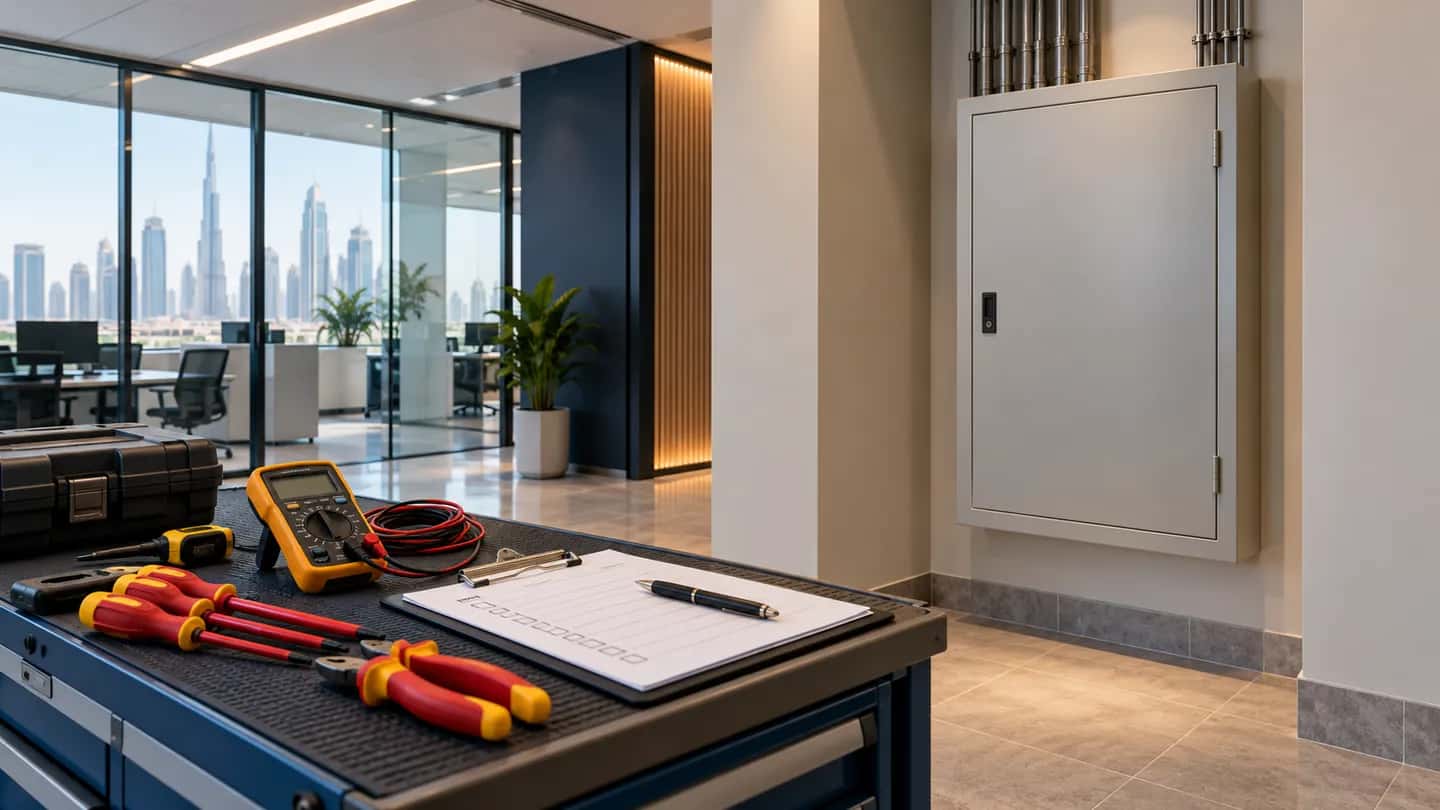
For your enquiry, send the office location, the symptoms, the affected areas and a preferred access window through Fixpoint’s quotation form. Explain whether you need a repair assessment or a discussion about planned maintenance. The team must confirm the arrangements before work proceeds. The hero image is an Illustration of an office maintenance setting; it is not a photograph of a completed Fixpoint project.
Sources and editorial context
Reviewed 19 October 2026. DEWA summer precaution guidance: https://www.dewa.gov.ae/en/about-us/media-publications/latest-news/2023/07/dewa-urges-customers-to-implement-precautionary-measures . General electrical safety information: https://www.esfi.org/home-safety/electrical-safety/ . This is a customer preparation guide, not an electrical procedure or a project compliance certificate.
What you can safely check
Safe preparation is administrative: record the affected rooms, photograph visible symptoms only from a safe position, obtain building access information and identify the person who can approve the work. Do not open a distribution board, remove a socket, test conductors or attempt live repairs. If there is smoke, sparking or a burning smell, move people away and seek emergency assistance through the appropriate local channel.
Next step
If you need professional help, request a quote with photos and access notes.