
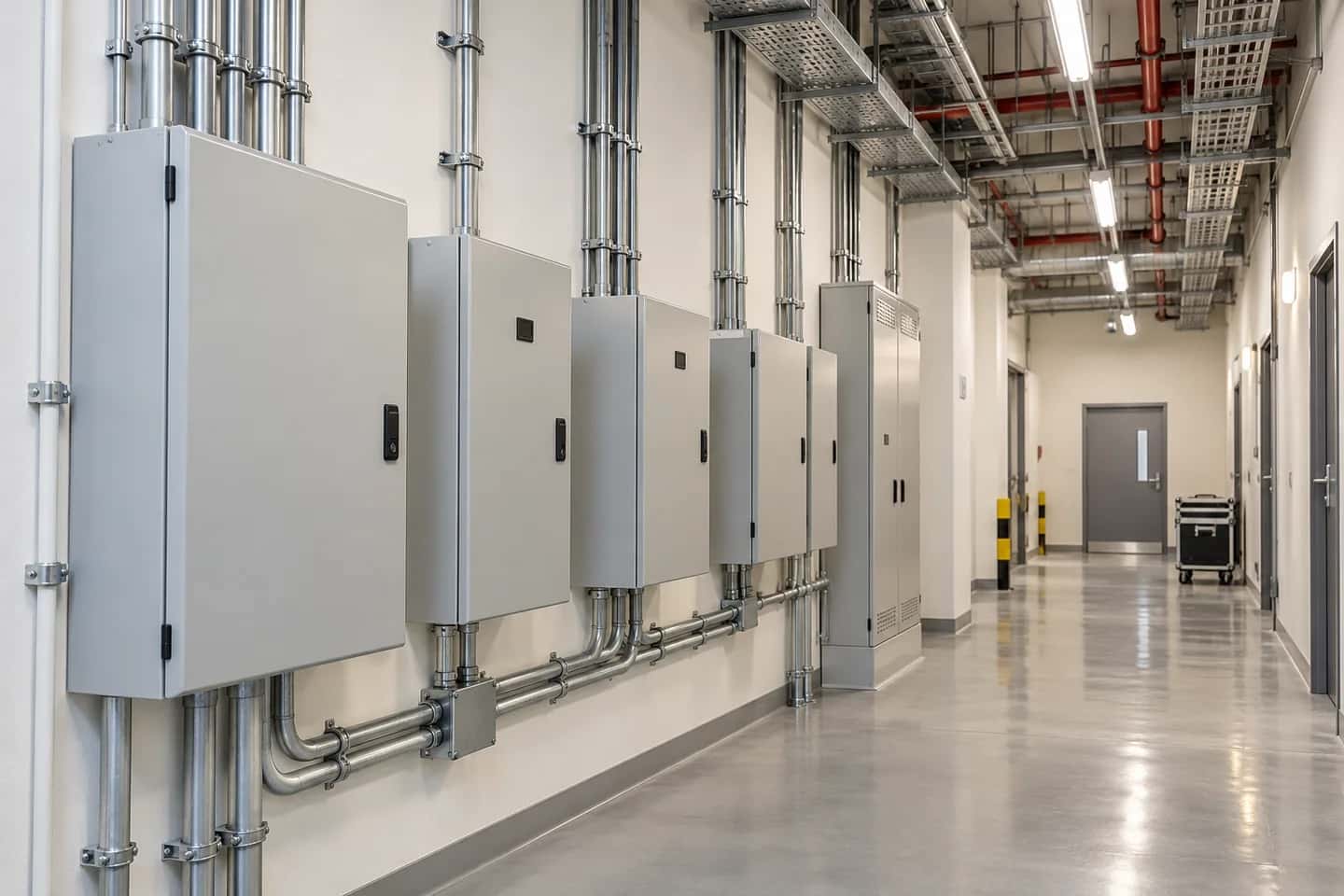
What must be ready before installing a distribution board?
Confirm the approved design, equipment specification, location, access and cable interfaces before installation. Coordinate procurement with the manufacturer and project team. Identify inspection, testing and documentation requirements early. Physical installation is one stage of the package; safe connection and energisation require the responsible competent professionals and project procedures. UAE project teams should confirm the applicable authority and building requirements for the particular site.
Start with the design information
A distribution board should be selected against the electrical design rather than by its external size or the number of available ways alone. Obtain the relevant schedules, drawings and specifications from the responsible designer. Resolve discrepancies before ordering. Make sure the procurement team understands which information is approved and which remains provisional. This prevents a commercially attractive order from locking the project into equipment that no longer matches the final design.
Clarify the manufacturer and installer interface
The panel or board supplier and the installation contractor may have different responsibilities. Identify who provides equipment drawings, product documentation, delivery information and any required specialist attendance. Agree the boundary between factory work and site work. Schneider Electric's distribution switchboard guidance discusses verification of assemblies; project teams should obtain the documentation applicable to their actual equipment. Do not assume that a generic product catalogue is the complete evidence required for the supplied assembly.
Check the room and location
Review equipment positions against the approved arrangement and the practical needs of access and maintenance. Confirm that the room or wall is ready and that other trades will not obstruct the installation. Coordinate doors, finishes and nearby services. The applicable clearances and environmental requirements must come from the responsible design and product information. Avoid substituting generic dimensions from another project. Record readiness before delivery so heavy or sensitive equipment is not brought into an unsuitable area.
Plan delivery and handling
Confirm equipment dimensions and handling requirements with the supplier. Review the delivery route, unloading arrangements and any restrictions inside the building. Assign responsibility for receiving inspections and damage reporting. If storage is necessary, agree a suitable location and follow the supplier's requirements. Installation schedules should account for these logistics. A board arriving on time at the site gate does not mean it can immediately reach its final position or be accepted for installation.
Coordinate cable entries and surrounding services
Check the intended entry arrangements and the relationship between the equipment and incoming routes. Resolve clashes before containment and other services become fixed. Make sure the team uses the relevant equipment drawings rather than an outdated tender outline. Where site changes affect an assembly, refer them through the appropriate approval process. Unplanned modifications can create technical and documentation issues, so convenience at the work front should not determine the final arrangement.
Track materials and identification
Maintain a record linking the installed equipment to its approved references and supplied documents. Keep labels and circuit identification aligned with the final schedules. If room names or circuit descriptions change, update the related records together. Clear identification helps the facilities team understand the installation and supports later maintenance. Avoid generic descriptions that make several different circuits look identical. Final identification should be checked against the installed arrangement by the responsible team.
Build testing into the programme
Testing should have defined prerequisites, responsible personnel, required instruments and records. Agree who reviews results and handles defects before any planned energisation. Do not treat the presence of a testing instrument as evidence that an installation is ready. The sequence must follow the relevant requirements and site procedures. Commercial pressure to complete a room should not remove necessary checks or turn an unresolved technical question into an undocumented site decision.
Prepare the handover evidence
Agree the final document list before installation begins. It may include approved equipment information, installation records, applicable verification documents, test reports, schedules and operating information. Check the exact project requirements rather than promising a universal certificate package. Make the records easy to match to the installed board. Store the final accepted documents in a clear folder structure so the facilities team does not have to search a large collection of unrelated files.
Hold a procurement readiness review
Before releasing the equipment order, bring together the responsible design, procurement and installation representatives. Review the current schedules, equipment drawings, location and delivery needs. Identify every unresolved item and its potential consequence. If the project chooses to order before all information is settled, record the decision and the specific uncertainty rather than treating the order as fully coordinated.
For example, a change in the equipment layout may affect surrounding containment or the route into the room. A revised delivery date may affect when the installer can complete associated work. These are planning scenarios, not reasons to delay every order indefinitely. They help the team make an informed decision and communicate the consequences to the people managing the programme.
Repeat a shorter readiness review before delivery. Confirm that the receiving area is suitable, the route is available and the relevant personnel know their responsibilities. Check how damage, missing documents or discrepancies will be recorded. Finally, link the equipment reference to the handover index from the beginning. This means supplier records can be filed as they arrive instead of being collected hurriedly at the end. The installation team then has a clearer picture of both physical readiness and the documentation needed to complete its package.
Make the equipment register usable
Create a register showing each board reference, location, supplier, drawing revision, delivery status and outstanding documentation. Link it to the programme and handover index. Use the register to identify missing information before the equipment reaches site. Once installed, confirm that the location and identification match the accepted records. If a reference changes, update related schedules and reports together. This prevents the facilities team from receiving several names for the same item. Keep the register concise and maintainable; its value comes from accurate current information, not from adding columns that nobody updates during procurement and construction.
Discuss your installation package with Fixpoint
Send the relevant schedules, equipment information, drawings and programme with your enquiry. Identify whether the equipment is supplied by you or included in the proposed subcontract. Explain room readiness, delivery restrictions and the expected testing responsibilities. Ask Fixpoint to list dependencies that could affect mobilisation or completion. This allows the installation package to be discussed as a coordinated sequence instead of a single line item with unclear boundaries.
How do DB fixing, dressing and installation scopes differ?
A distribution board installation quotation should distinguish fixing the enclosure, arranging and identifying the associated wiring, completing specified connections, and providing the required inspection and test records. Site teams may call the arrangement of conductors inside a board DB dressing, but that label alone is not a complete specification or evidence that the board is ready for energisation.
When comparing a DB dressing package with a broader LV panel installation package, identify the exact equipment references. A final distribution board, sub-main distribution board and main distribution board can involve different supplier interfaces and project responsibilities. Use the approved schedules and equipment documents to define the work instead of applying one generic description to every panel.
Ask each bidder to state whether its price includes delivery and positioning, fixing, cable entry accessories, identification, termination, testing coordination and handover documents. Clarify which items remain with the panel manufacturer or another appointed specialist. Where equipment is already installed, record the condition and information available before agreeing alterations; photographs alone cannot confirm spare capacity or suitability.
For acceptance, match the installed equipment reference to its circuit schedule and applicable inspection records. Keep outstanding technical decisions visible to the responsible electrical professional. This approach helps a main contractor compare quotations for DB installation in the UAE without mistaking a tidy appearance or a completed fixing activity for a fully verified assembly and installation.
Related reading
Electrical Testing and Commissioning Readiness https://fixpoint.ae/en/blog/electrical-testing-commissioning-readiness
Electrical Snagging and Handover Checklist https://fixpoint.ae/en/blog/electrical-snagging-handover-checklist
Reference
Reference guidance https://www.electrical-installation.org/enwiki/Distribution_switchboards Confirm project-specific requirements with the responsible professionals.
Request an electrical quotation https://fixpoint.ae/en/get-a-quote
Hero image: illustrative editorial illustration; not a photograph of a completed Fixpoint project.
Next step
If you need professional help, request a quote with photos and access notes.